Docs as Code: Why It Keeps API Documentation Accurate

Oluwatise Okuwobi
Content Marketing Manager

Your documentation was accurate when it shipped. That was three releases ago. Since then, the quickstart has been referencing a deprecated endpoint, the auth guide describes a flow you replaced in Q1, and the webhook section documents a payload format that changed in March. Nobody noticed until a customer filed a ticket last Tuesday asking why the code example returns a 404.
This is the most common failure mode in API documentation, and it has almost nothing to do with writing quality. The docs were good when they launched. They just didn't stay current because nothing in the workflow forced them to. The code moved, the docs didn't, and the drift accumulated silently until someone on the outside caught it.
Every stale page is a cost: a support ticket that shouldn't exist, an integration that takes a week instead of a day, a developer who hits a broken example and quietly switches to a competitor. The damage compounds because nobody is tracking which pages drifted from the codebase.
Docs-as-code is the workflow that fixes this. It treats documentation like software: version-controlled, reviewed in pull requests, tested in CI, deployed alongside the code it describes. If you want the full framework definition, Write the Docs' guide is the industry reference. This post is about what happens when you apply it, the specific mechanisms that prevent drift, and what accuracy at scale actually looks like.
What docs-as-code actually means
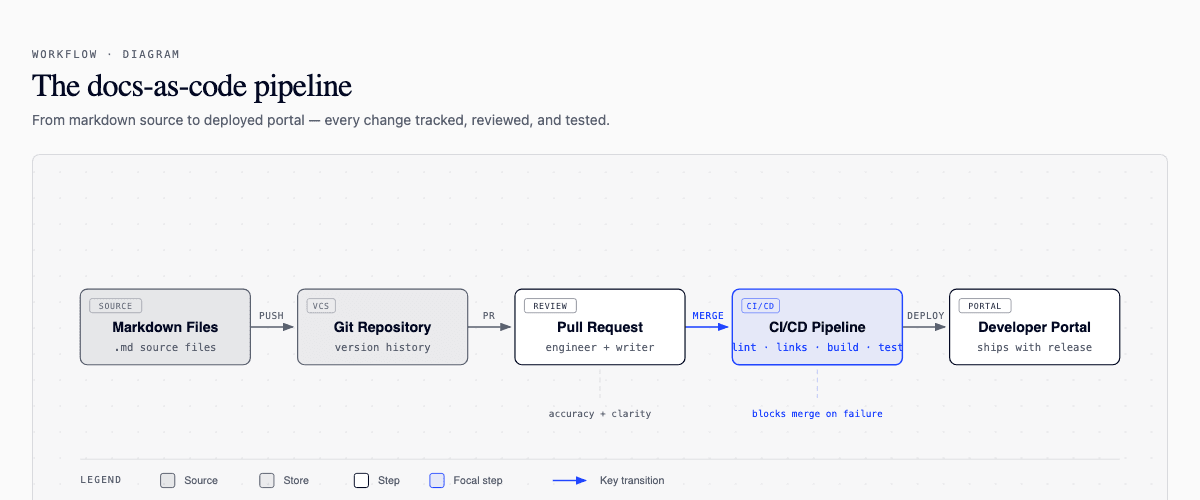
The concept is exactly what it sounds like: apply the same tools and workflows you use for code to your documentation. Write in plain text (markdown or a similar format), store it in version control (Git), review changes through pull requests, run automated checks in CI/CD, and deploy through a pipeline.
The important part isn't the tooling. It's the consequence: when documentation lives in the same workflow as code, changes to one can trigger, require, or block changes to the other. An engineer can't merge a PR that changes an API endpoint without updating the corresponding doc page, because the doc update is part of the same review. A doc change that breaks a link or introduces an error gets caught by the CI pipeline before it ships.
That coupling between code and docs is what prevents drift. Everything else, the markdown, the Git repo, the static site generator, is implementation detail.
Why your documentation keeps going out of sync
Before getting into the fix, it's worth naming the failure modes precisely. Documentation doesn't go stale randomly. It goes stale in the same three ways at almost every company we've worked with.
Documentation and code live in different systems
The most common setup: code lives in GitHub, documentation lives in Confluence, a CMS, or a standalone platform with no connection to the codebase. When an engineer changes an endpoint, there's no mechanism that says "the docs need updating." The engineer finishes the code PR, it gets merged, the release ships, and the documentation stays exactly where it was.
This isn't a discipline problem. It's a systems problem. When docs and code live in different places with different workflows, keeping them in sync requires someone to manually remember, every time, for every change. That works when you have five endpoints and ship once a month. It stops working the moment either number grows.
Nobody owns the update
The engineer who changed the endpoint assumes the writer will update the docs. The writer who wrote the docs doesn't know the endpoint changed, because the change happened in a codebase they don't monitor. The PM assumes someone handled it. Three months later, a customer discovers the getting-started guide references an auth flow that no longer exists.
This is an ownership gap, not a staffing gap. Companies with full time technical writers still hit this problem when the writer isn't wired into the code review process. The fix isn't "hire more writers." The fix is a workflow where doc updates are part of the code change, not a follow-up task that someone might remember.
No automated check for drift
Without CI tests, broken code examples and outdated endpoint references accumulate silently. The documentation looks complete, the pages render, the navigation works. Nothing signals that the content is wrong until a developer tries to follow the instructions and fails.
Most codebases have automated tests that catch regressions. Most documentation has nothing. No link checker, no linter, no test that validates whether the code examples still run against the current API. The result is documentation that degrades invisibly with every release, and nobody finds out until the support tickets arrive.
How docs-as-code fixes it
Each component of the docs-as-code workflow maps directly to one of those failure modes. Version control fixes the "different systems" problem, PR review fixes the "nobody owns the update" problem, and CI/CD fixes the "no automated check" problem.
Version control as the single source of truth
When documentation lives in Git, every change is tracked, attributed, and reversible. You can see who changed what, when, and why. You can diff the current docs against any previous version. You can branch, experiment, and roll back without risk.
More importantly, when docs and code share the same repository (or tightly linked repositories), a pull request that changes an endpoint can include the doc update in the same changeset. The reviewer sees both changes together: the code change and the doc change. If the doc update is missing, it's visible in the diff. That visibility alone prevents a significant portion of documentation drift.
For teams that keep docs in a separate repo, the coupling is looser but still workable. Cross-repo CI checks can flag when a code change touches an endpoint that has corresponding documentation, prompting the author to update the docs in a parallel PR.
Pull request review for documentation
The same review process that catches bugs in code catches errors in documentation. An engineer reviews doc changes for technical accuracy (does this match what the API actually does?), a writer or editor reviews for clarity (can a developer who's never seen this API follow these instructions?).
Nobody merges a doc update without a second pair of eyes. That sounds like it would slow things down, and it does add a step. But the alternative, shipping unreviewed doc changes and discovering the errors through customer support tickets, is slower and more expensive.
The review step also solves the ownership problem by making it explicit. When a code PR requires a corresponding doc update, and the doc update requires review, the responsibility chain is clear: the engineer who made the change, the writer who documented it, and the reviewer who approved it. No ambiguity about who was supposed to handle it.
CI/CD for documentation
This is the automation layer. A documentation CI pipeline can run:
Link checkers that catch broken internal and external links before they ship
Prose linters (Vale, markdownlint) that enforce style consistency and catch common errors
Build tests that verify the documentation site generates without errors
Code example validators that run sample requests against the test environment and flag failures
OpenAPI spec diffing that detects when the API definition changed but the corresponding guide didn't
When a doc change breaks something, the pipeline fails and the merge is blocked. When a code change breaks a doc reference, the cross-repo check catches it. Documentation quality becomes a build-time concern, not a post-ship discovery.
The setup cost is real but one-time. Configuring Vale rules, writing a link checker script, connecting the spec differ to your API repo. Once the pipeline is running, it catches problems automatically. The ROI is measured in support tickets that never get filed.
Automated generation where it fits
Some documentation should be generated from the source code: API references from OpenAPI specs, SDK method signatures from code comments, changelog entries from commit messages. These are the parts where human writing adds no value and manual maintenance guarantees drift.
The parts that should stay human-written: quickstarts, conceptual guides, error explanations, getting-started flows. These require judgment about what the developer needs to know, in what order, and at what level of detail. AI and automation can draft these, but someone needs to own whether the draft is right, current, and useful [Internal Link: multi-product documentation structure → /blog/multi-product-documentation-structure].
The best docs-as-code workflows automate what can be automated and invest the saved time in the editorial work that actually requires a human.
What accuracy at scale actually looks like
The workflow sounds reasonable in theory. Here's what it looks like in practice.
Yuno is a payment orchestration company with a fast-moving API. Features ship frequently, endpoints change, new payment methods get added. Their documentation runs on Mintlify with a docs-as-code workflow: markdown in Git, PR reviews for every change, automated builds on merge.
The result: developers reach their first successful API call in 15-20 minutes, product adoption increased over 50%, and Yuno won the Best Payment API Award with enterprise customers citing documentation quality during evaluation. That quality isn't just about structure or design. It's about accuracy. When a developer follows Yuno's quickstart, the code examples work because the pipeline ensures they work. When an endpoint changes, the docs update in the same release cycle.
CarePortals, a health tech company with three separate products, applied a similar approach. Documentation structured using the Diataxis framework, maintained through a docs-as-code workflow. The result: 20+ developer hours saved per week, primarily from eliminating the manual work of tracking what changed and updating docs after the fact.
The common thread isn't the platform, it's the workflow. Documentation that stays accurate because the process makes drift visible and fixable before it reaches the customer.
What to adopt first if you're starting from scratch
You don't need to implement the full workflow overnight. Here's the sequence that produces the most value fastest.
Start by moving docs to markdown in a Git repository, even if it's a separate repo from the code. This immediately unlocks version history, branching, and the ability to review changes in pull requests. If your docs currently live in Confluence or a CMS, this is the migration that matters most.
Once the docs are in Git, require PR review for every doc change. One reviewer for technical accuracy, one for clarity. This single step catches most documentation drift because it forces someone to verify the content before it ships. It also makes the ownership question explicit: the PR author, the reviewer, and the merge decision are all visible.
From there, add a CI step for link checking and linting. Vale for prose quality, markdownlint for formatting, a script that crawls internal links and flags 404s. This is the first automation layer, and it catches the errors that accumulate silently in unmonitored docs.
When you're ready, connect your API spec to auto-generate the reference. If you have an OpenAPI spec, tools like Mintlify, ReadMe, and Redocly can generate your API reference automatically. Keep the guides and quickstarts human-written, auto-generate the parts that should mirror the spec exactly.
The last step is deploying docs through the same pipeline as the product. When a release ships, the docs ship with it. No separate deployment process, no "we'll update the docs next week." Same pipeline, same timeline.
You don't need a custom documentation platform, a dedicated docs team, or a complete rewrite to start. The workflow is the investment, not the tooling
Docs-as-code vs. the alternatives
Docs-as-code isn't the right approach for everything. Here's where it fits and where it doesn't.
Wikis and Confluence are easy for non-technical contributors, good for internal knowledge bases. But they offer no version control, no CI pipeline, no mechanism to prevent drift between code and docs. If your documentation is internal-only and doesn't need to stay in sync with a codebase, a wiki is fine. For developer-facing API documentation that changes with every release, it breaks down.
A CMS (headless or traditional) works for marketing content and knowledge bases, but lacks the Git integration and CI pipeline that prevent drift. Some CMS platforms are adding Git-backed storage, which is effectively docs-as-code with a visual editor, a sign that the approach is becoming the default even for teams that don't want to work in markdown directly.
WYSIWYG doc platforms like GitBook, ReadMe, and Mintlify sit in the middle. They offer Git-backed storage, some CI features, and API playground integrations while keeping a visual editor for contributors who aren't comfortable in a code editor. For many teams, this is the practical compromise: the benefits of docs-as-code without requiring every contributor to work in a terminal.
Docs-as-code can also be overkill. If you have five pages of documentation and one person maintaining them, a Git workflow adds ceremony without proportional benefit. The approach scales, that's its strength. The overhead is worth it when you have enough documentation, enough contributors, and enough release velocity that manual coordination stops working. For most API companies, that threshold arrives sooner than they expect.
Conclusion
Documentation goes stale because docs and code live in different systems with different workflows. Nobody notices when they drift apart, and nothing in the process forces them back together. By the time a customer discovers the docs are wrong, the damage has been compounding for months.
Docs-as-code fixes this by applying the same tools and processes you already use for code: version control so every change is tracked, pull request review so every update is verified, and CI/CD so broken examples and dead links get caught before they ship.
If you're starting from scratch, three things to adopt first:
Move docs to markdown in Git. This unlocks everything else.
Require PR review for doc changes. This alone prevents most drift.
Add a CI step for link checking and linting. This catches what humans miss.
The platform matters less than the workflow, the tooling matters less than the discipline. Most companies that struggle with documentation accuracy don't have a writing problem, they have a systems problem, and docs-as-code is how you fix it.
We've helped API companies implement these workflows and measure the accuracy improvements. See what it looked like case studies

