Technical writing agency or in-house hire? A cost breakdown

Cassiano Moraes
CEO
TL;DR
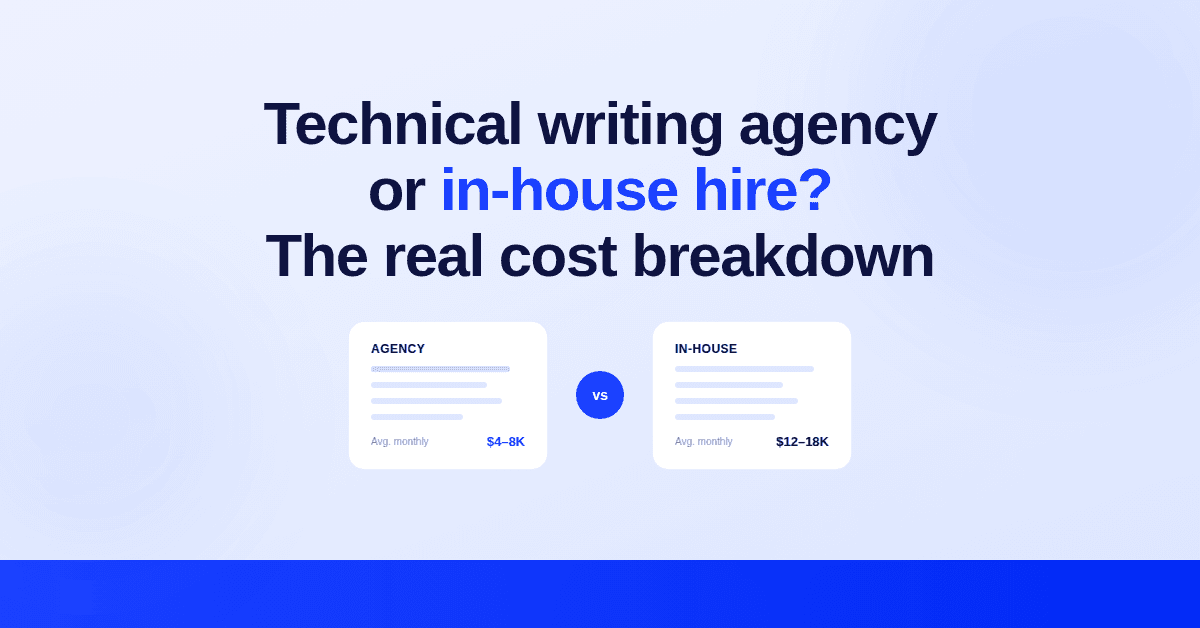
You need documentation. The job posting has been open for two months, or you're about to write one. But once you add up salary, benefits, tools, ramp-up time, and the management overhead nobody mentions, the cost of a single in-house technical writer looks nothing like the number on the listing.
Meanwhile, your docs are stalling product adoption right now. Every week without functional documentation is a week your engineers spend answering questions that docs should handle, and a week your customers spend deciding whether to integrate or walk away.
This post breaks down the real cost of hiring in-house versus working with a technical writing agency, with actual numbers. Not to sell you on one answer, but to give you the math so you can make the call yourself.
What does it actually cost to hire an in-house technical writer?
A mid-level technical writer in the US costs $80,000 to $110,000 in base salary. Add benefits, tools, management overhead, and ramp-up time, and the true first-year cost lands between $135,000 and $265,000 before they've shipped a single page of documentation.
The salary number is the one people fixate on. It's also the smallest gap between expectation and reality.
Base salary
According to the Bureau of Labor Statistics, the median annual wage for technical writers is around $80,000. Glassdoor puts the average closer to $85,000, with senior writers clearing $110,000.
But those are general numbers. If you need someone who can write API documentation, read code, and speak to developers without a translator, you're looking at $100,000 to $140,000+. Fintech and developer tools companies pay a premium because the pool of writers who understand both the technology and the audience is small.
The costs nobody puts in the job listing
Benefits add 25-40% on top of base salary. Health insurance, 401(k) matching, payroll taxes, PTO. For a writer making $100,000, that's another $25,000 to $40,000 per year that never appears in the offer letter but shows up in your budget.
Ramp-up reality
A new hire needs 2 to 3 months to understand your product, codebase, API surface, and voice before producing at full speed. That's $15,000 to $35,000 in salary paid during a period where output is limited to learning, shadowing, and drafting content that needs heavy revision.
This isn't a knock on the writer. It's the nature of technical documentation. You can't write accurately about a payments API without understanding the settlement flow, the error states, and the edge cases that support tickets reveal over time.
The full picture
Cost component | Low estimate | High estimate |
|---|---|---|
Base salary | $80,000 | $140,000 |
Benefits (30%) | $24,000 | $42,000 |
Ramp-up (unproductive months) | $13,000 | $35,000 |
Year 1 total | $117,000 | $217,000 |
This accounts for one person, one domain, one product line. If they leave after a year, you start from zero: new posting, new search, new ramp-up. The knowledge walks out the door with them.
How much does a technical writing agency cost?
Technical writing agency pricing depends on the engagement model. Project based work typically runs $5,000 to $15,000 for a complete documentation portal. Retainer or embedded models range from $1,600 to $6,000 per month, which gets you a full team (writers, designers, developers) for roughly the annual cost of one senior in-house hire.
The comparison most people make is agency monthly rate versus writer monthly salary. That's the wrong comparison. A salary buys you one person. An agency retainer buys you a team with a process.
Per-deliverable pricing is less common. You pay per guide, per page, or per documentation set. It works for one-off needs (a single integration guide, a README rewrite) but breaks down when scope is fluid or ongoing.
Model | Typical cost | Best for | What to consider |
|---|---|---|---|
Project based | $5,000-$15,000 | Portal builds, overhauls, migrations | Ends when the project ends |
Retainer/embedded | $800-$3,000/month | Ongoing docs maintenance, continuous updates | Requires clear scope definition |
What you get that a single hire can't deliver
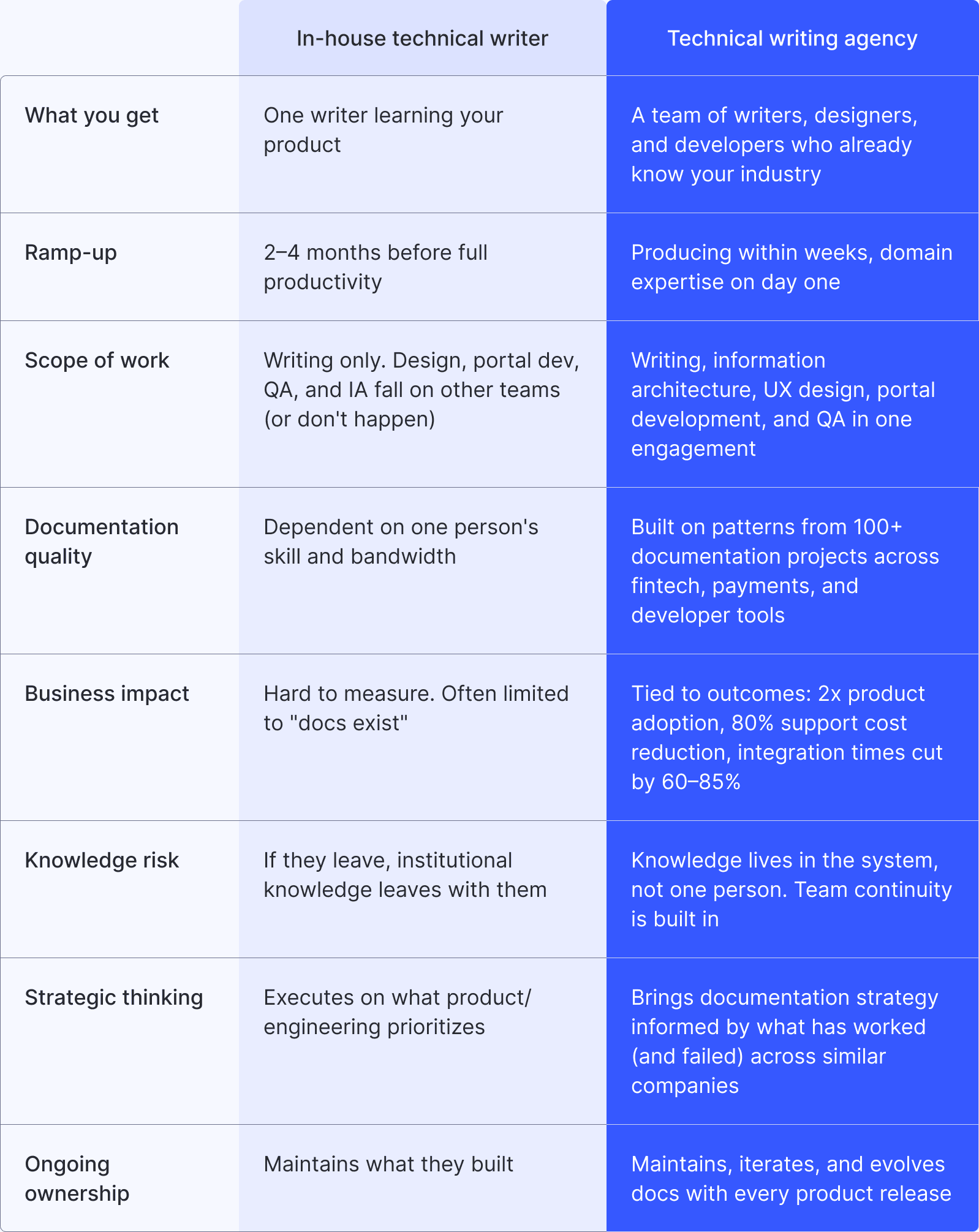
An agency brings a team. At WriteChoice, that means technical writers, UX designers, developers, and QA working on your documentation simultaneously. A single in-house writer does one of those things.
Specialized agencies already know your domain. If an agency has written fintech API docs before, they're not spending three months learning what a settlement flow is. They've seen the patterns across dozens of similar products. That eliminates the ramp-up gap that makes in-house hires expensive in year one.
Speed is the other difference. A complete developer portal delivered in 6 to 8 weeks is normal for a specialized agency. A single writer building the same thing from scratch, while also learning the product, is looking at 4 to 6 months at minimum.
Platform expertise matters too. Agencies that do this full time work across Internal Link: ReadMe, Mintlify, Docusaurus, Stoplight, and GitBook. They can recommend the right platform for your use case, handle the migration, and build the portal. An in-house writer typically knows one platform well and is learning the rest on your dime.
Where agencies fall short
No agency knows your product as deeply as someone who sits in your office and attends every sprint meeting. On day one, an in-house writer has hallway access to engineers. An agency has scheduled syncs and Slack channels.
For products with extremely deep institutional context (think: years of technical debt, undocumented internal APIs, tribal knowledge that lives in three engineers' heads), an agency will need more onboarding support from your team than a typical engagement assumes. That's not a dealbreaker, but it's worth knowing upfront so you scope the engagement honestly.
In-house vs outsourced: when does each make sense?
Hire in-house when documentation is a core daily function tied to a single complex product that requires deep institutional context. Outsource to a technical writing agency when you need speed, breadth across multiple products, or don't have the internal structure to manage a documentation function.
Most companies frame this as an either/or decision. It doesn't have to be.
When outsourcing to an agency makes more sense
An agency fits when you need documentation built or overhauled faster than a single hire can deliver, or when the scope doesn't justify a full time headcount.
You need a complete developer portal and you need it in weeks, not months. Tonder went from a 2 month integration time to 10 days after a documentation overhaul. A single writer wouldn't have shipped that in the same window.
You have multiple products or APIs that need documentation simultaneously. One writer works sequentially. An agency team works in parallel.
You don't have a docs lead and nobody on the product or engineering team has bandwidth to manage a writer. An agency manages itself. You review output, not process.
You need more than writing. You need information architecture, UX design, portal development, and QA. That's 3 to 4 hires, or one agency engagement.
You're at Seed or Series A and documentation isn't a full time job yet, but it's actively blocking adoption. Yuno saw a 50%+ increase in product adoption after restructuring their docs. That kind of result can't wait for a 4 month hiring process.
The hybrid model
The smartest path for most SaaS companies between 50 and 200 employees is a combination: bring in an agency to build the portal, establish the information architecture, and set the standards. Then decide whether to hire in-house for day to day maintenance or keep the agency embedded.
This works because the hardest part of documentation isn't the ongoing updates. It's the initial build: defining the structure, choosing the platform, writing the foundational content, and designing the portal. That's project work. It has a clear start and end, and it benefits from a team that's done it before.
Nayax took this approach. WriteChoice built and unified documentation across 10+ products into a single portal that now receives 80,000+ monthly visits with an 80% reduction in support costs. That foundation would have taken a single in-house writer over a year to build. See the full case study
Decision matrix
Factor | Hire in-house | Outsource to agency |
|---|---|---|
Time to first output | 3-5 months (hire + ramp) | 2-4 weeks |
Annual cost (year 1) | $135,000-$265,000 | $5,000-15,000 |
Team composition | 1 person | Writers + designers + devs + QA |
Platform expertise | Usually one platform | Multiple platforms |
Institutional knowledge | Deep (over time) | Moderate (with onboarding support) |
Scalability | Linear (hire another person) | Flexible (adjust scope) |
Continuity risk | High (if they leave, you restart) | Low (team, not individual) |
Best for | Single complex product, daily docs cadence | Portal builds, multi-product, speed-critical |
How to choose a technical writing agency
Look for domain expertise in your industry, a team that goes beyond writing, platform experience with your documentation stack, and proof of outcomes with real numbers. Portfolios show what an agency can produce. Case studies with metrics show what that production actually did for the business.
Most agencies will tell you they can handle your docs. The difference between a good engagement and a wasted quarter comes down to how specific their answers are when you push past the pitch.
What separates a good agency from a content shop
Industry specialization is the fastest filter. An agency that has written API documentation for fintech companies before will ramp in days, not months. They already know what developers expect from a payments API reference, how to structure authentication flows, and where most integration guides fall apart. A generalist content agency will need your engineers to teach them all of that, which defeats the purpose of outsourcing.
Ask who works on your documentation besides writers. If the answer is "just writers," you're getting content production, not a documentation program. You need information architecture, UX design for the portal, front end development, and QA testing against live endpoints. At WriteChoice, a typical engagement includes technical writers, UX designers, and developers working in parallel. The team composition tells you what you're actually buying.
Platform expertise matters more than most companies realize. Does the agency work with your documentation platform? Can they recommend a better one if yours isn't working? Can they handle the migration? Agencies that specialize in developer documentation work across ReadMe, Mintlify, Docusaurus, Stoplight, and GitBook. They've seen what works for different use cases and what doesn't. That experience saves you months of trial and error.
Then look at how they talk about results. "We wrote 50 pages of documentation" is a deliverable. "Integration time dropped from 20 days to 7 and support tickets fell by 50%" is an outcome. PagBank saw exactly that: integration time went from 20 days to 7, and customer satisfaction jumped from 29% to 89% after a documentation overhaul. CarePortals saved their engineering team 20+ developer hours per week by structuring documentation for 3 products using the Diataxis framework. Ask for the second kind of proof, not the first. See more case studies
Red flags
No case studies, or only anonymous ones. If an agency can't name a client and share a specific metric, the results probably weren't worth naming.
The entire pitch is about their writing process with no mention of design, development, or portal build. You're hiring a content mill, not a documentation partner.
No experience with your documentation platform or developer audience. Writing marketing copy and writing API references are different disciplines.
Project based only with no maintenance option. They'll build it and leave. Six months later your docs are out of date and you're back where you started.
Pricing based on word count or page count. This incentivizes volume over quality. You want fewer, better pages, not more of them.
Questions to ask on the first call
What industries and documentation types do you specialize in?
Who is on the team besides writers? Do you handle design and portal development?
Which documentation platforms have you worked with? Can you show a portal you've built?
Can you share a case study with specific outcome metrics (support tickets, integration time, adoption)?
What does your maintenance model look like after the initial build?
How do you handle onboarding when you don't have deep product context on day one?
The bottom line
An in-house technical writer costs $80,000 to $140,000 in year one when you count salary, benefits, tools, recruiting, management overhead, and ramp-up. Output doesn't hit full speed for 2 to 3 months.
A technical writing agency gives you a cross functional team for roughly the cost of one senior hire, with output starting in weeks instead of months.
Freelancers work for defined, short-term deliverables. They don't work for building and maintaining a documentation program.
The path that works for most SaaS companies between 50 and 200 employees: agency to build the foundation and set the standards, then decide whether to hire in-house for maintenance or keep the agency embedded.
The question worth asking isn't "which option is cheaper?" It's "which one gets your documentation unblocked fastest with the least management overhead?" The answer depends on your product complexity, your team's bandwidth, and how urgently your docs are blocking adoption.
If you're weighing these options right now, book a call with us. We'll walk you through what the engagement looks like for your specific stack and product set.

